Wednesday, May 12, 2010

The beautiful game

Everyone knows football reigns supreme in Argentina, and nowhere is this more the case than in Buenos Aires, which plays host to El clasico, the derby between the capital's ultimate rivals: Boca Juniors and River Plate. (Yeah, weird name I know, pronounce it like you would in English but with a Spanish accent--It comes from Buenos Aires' iconic Rio de la Plata, or River of Silver, which apparently was mistranslated by early British residents.  I need to check on that, though.)

Boca Juniors (home colours: blue and gold), erstwhile club of Maradona, is Argentina's most well-known and supported club, particularly outside the country, but within the country, River Plate (home colours: red and white) isn't too far behind.  As soon as an Argentine finds out that you care in the least about football, they will inevitably ask you, "De quien sos hincha?" ("Who do you support?") And woe betide whoever gives the wrong answer!

One thing that sets the teams apart could be said to be class.  Although I've been met with half-hearted rejections of the theory (most often from admittedly well-to-do River fans), most would agree that the fan base of Boca is by and large the working class, while the patrons of River, although they come in all shapes and sizes, are more often than not...shall we say...more financially stable?  The location of Boca's and River's stadiums, La Bombonera and Monumental, respectively, speaks volumes in this regard.  While La Bombonera is on the banks of the noxious, reeking Riachuelo canal in the dangerous southern barrio of La Boca, Monumental is in the more affluent northern Belgrano/Nunez neighbourhoods with their peaceful tree-lined avenues and upmarket eateries.  The stadiums themselves reflect the economic difference, too: Monumental hosts international matches, and can seat 66,000 spectators in relatively comfortable conditions.  The Bombonera, on the other hand, though only able to seat 49,000, is by far the most atmospheric football experience to be had in Argentina.

La Bombonera, with its steep, close stands

My first experience with Monumental and Argentine football in the flesh was at an international match between Argentina and Peru, a rather important one in fact--a qualifying match for FIFA World Cup 2010.  The opportunity came about unexpectedly; I sometimes worry that I am too much of a plan-oriented person and envy those into whose laps adventure seems to fall because of their spontaneity and willingness to let the wind carry them where it will.  This is one of the reasons I chose Argentina although I didn't have a particularly good reason to go there or anything lined up.  It's also the reason I jumped at the chance to see go to my first international match in Argentina despite being in a bit of a financially tight spot at the time.  I was hanging out with some friends in Recoleta one Sunday afternoon when Johan, a Colombian-American friend mentioned he had an extra ticket to the match he would sell to anyone who wanted to go.  A bit later that afternoon I was debating going and after finally deciding to, I went back and told  him I'd take it...only to find out he'd just sold it to another friend!  But they suggested I might be able to get a ticket at the gate from a hawker, so that's what I did, and after a bit of haggling by yours truly, it turned out to be not only cheaper than theirs, but in a better position!  Of course the downside of this was that I was alone in a row of strangers for the match...

But it was a good experience anyway.  I got to see Maradona pacing the sideline in his requisite tracksuit (which he never seems to be without), a bit of Messi magic (although he definitely disappoints a bit on the international stage as opposed to when he plays for Barca), and an absolutely torrential downpour.  It was possibly the heaviest rain I've ever experienced, and that while sitting passively out in the open with nothing to shelter under!  It started around halftime and never let up significantly for one moment.  In the last ten minutes, I retreated to an upper level of the stands to stand under a very inadequate outcropping of cement.  In fact, by the end it was so torrential that, Peru having equalized on the 89th minute, I was turning to go when I sensed some buildup from the noise.  Sure enough, as I squeezed my face in between the squelching and slick flanks of two stout supporters, Palermo notched Argentina's second of the night in the last minute of injury time, sending the whole stadium into wild paroxysms of joy.  The crowds outside made the prospect of and my futile attempt at taking public transport home totally unrealistic, so I walked the 25 odd blocks home in the deluge, my trainers squeaking and splashing every step of the way, but a smile on my face.

My next experience was at the hallowed grounds of La Bombonera, once again with Johan and co., although this time I was seated with everyone.  I should say standing, because at a Boca match there is pretty much standing room only.  Although the action on the pitch was forgettable--it was a 0-0 draw with Colon, the atmosphere was as electric as at any Boca match, bar only El Clasico.  The stands were a riot of blue and gold, the air heavy with chants of "Vamos, Boca, vamos!" and many other less savory cries that I won't print here.  A word to the wise though: if you ever go to a Boca match, it's a good idea to make sure you DON'T get a ticket in the La doce section (not sure if you can anyway, if you're not a season ticket holder)--this is Boca's notorious firm of hooligans.  It gets crazy in there, let me tell you.  The above picture is me at the match, with a (crazy) Argentine friend of Johan's.

My final football-spectating was a River Plate match at Monumental at the end of November '09, just before I finished my time in Argentina.  A student, Rodrigo, was kind enough to invite me to go with him, so I took him up on the offer.   Being a much more spatially open stadium (La Bombonera's stands are very steep and the atmosphere is almost claustrophobic because of the proximity of the rectangular stands to each other and to the pitch), Monumental doesn't have the same atmosphere, but the match itself was fun to watch as the sun dipped over the stand opposite ours and the heaviness of the warm summer evening set in.  The final result was a 1-1 draw with Estudiantes, which was fielding Juan Sebastian Veron himself, ex-Boca, Inter, Man Utd and Chelsea midfielder and a regular callup to the national side.  Also notable was another of Argentina's former national team members, Ariel Ortega, who scored River's exciting equalizer on the 90 minute mark.

I'm having troubles uploading any pictures of Monumental, I'll try again later.  Both photos above courtesy of Johan.

Friday, April 9, 2010

Eating in Buenos Aires

I just may think about food a bit too much.  I will often be wandering around a new city in the morning and find myself more focused on what to eat for lunch, what succulent morsel or guilty pleasure to indulge in, than the 800 year-old cathedral or world-renowned museum I am in, or the charming shop facades passing by.

Well that might be a bit of an exaggeration, but food is often on my mind, so what would this blog be if it didn't include a paean to foods of the world, in this case Argentine cuisine?

First and foremost, of course, is the asado.  From the verb asar, to roast or grill, the asado is basically the Argentine version of the barbecue.  But it is so much more.   While Americans and Brits fire up their portable grills in the summertime, Argentines have asados year-round, come rain or shine, snow or hail.  Thus they not only have a term for their grill--parrilla, but also for the hut/area in which it is housed in anticipation of inclement weather--quincho.  And it's no wonder--if you have tasted Argentine beef from its fertile pampas, expertly seasoned (although often salt is all that is needed and used) and grilled to succulent perfection--you will know just why they eat it year-round and never get tired of it.  Whether it's chorizo (a type of sausage), asado, or vacio (both different cuts), or what's more common, a large helping of all--the asado is something not be missed if you ever travel to Argentina.  I didn't experience as many as I would have wished for, but some notable ones were spent on the terraced rooftop of our apartment with my roommates, not to mention a memorable one at Ezeiza park with a friend, Fabian, and his family.  Below is my humble attempt to evoke an evening on the rooftop with good food and good friends.

Ode to the Asado
Beneath the fading sun of southern skies,
Parrillas coaxed to life on terrace tiles,
Chorizo and vacio hiss and fry,
As sultry tango floats, porteño guile,
Across the rooftops.  In reply--the scent
Of charcoal, meat, and sizzling fat, and sweat
And tears and blood and thirty years' dissent
And football hopes and laughter, no regrets.
     The meat is off the grill, the sun is gone,
     And wine and jokes flow till the break of dawn.

 With Diego, roommate/the best asador (griller) I know!

Pizza
Argentina, but specifically Buenos Aires, owes its incredible and unmissable pizza and pasta prowess to its Italian heritage, which accounted at peak times of immigration during the 20th century for almost as much as its numbers of Spanish immigrants.  Pizza is a funny thing, you know.  When I first arrived in Buenos Aires I couldn't get enough of this new style; it is different from American pizza, both the fast food and gourmet varieties, although both thin-crust and deep-dish styles exist there.  But by the end of my year (actually well before), I was craving p-p-pepperoni, which is nowhere to be found there!  American and Argentine pizzas both have their charms, though.

Food can be incredibly cheap down there, too; my regular local haunt was a place by the name of Fabrica de Pizzas, which offered medium-sized cheese pizzas (definitely better than your average fast-food cheese pizza this side of the Panama Canal) for anywhere from--depending on inflation--5 to 7 pesos ($1.29-$1.80).  Aaah!  A staple for me during my time at Calle P.I.Rivera 3720 B.  Another favourite--though slightly more expensive at 10 pesos a pizza--was Ugi's, very popular among the masses (trans-lingual pun, some of you out there will get it).

Empanadas
Sing, muse!  Enough cannot be said about the joys of empanadas.  Whether it's carne picada, carne suave, jamon y queso, roquefort, or pollo; whether it's cooked al horno (baked) or frito (fried); whether it's an empanada salteña (from Salta) or an empanada porteña (from Buenos Aires).  One of my regrets (the other being only taking one class of tango) is not learning to make empanadas while I was there.  It is basically a semi-circular pastry with a filling inside, either baked or fried, and muy cheap.  Normally 2 pesos a pop, occasionally 1.50, four easily made for a nice little meal, though of course if my finances were in good shape 5 or 6 never failed to hit the spot!  "Barriga llena, corazón contento" (gracias, Carlitos!)


Ice cream
Though asado remains my favourite staple among Argentina's cuisine, its ice cream surely comes a close second.  Another throwback to its large Italian immigrant population, helado finds its roots in the semi-fluid gelato, and Buenos Aires' barrios have refined the art to a perfection.  It may be a case of natural bias, but I honestly found nowhere in all my rambling and roaming of the capital that had as delicious ice cream as the ice cream parlour across the street from my apartment, Lucca.  People will try telling you Freddo, Persicco or Jauja.  Believe me, they don't come close.  Some standout flavours were Tiramisu, Pear, and Sambayón.
If you ever find yourself in Buenos Aires of a warm afternoon, hop on the Bartolomé Mitre train from Retiro, and get off at the station Coghlan.  Incidentally, the barrio (neighbourhood) of Coghlan was named after the station, rather than vice-versa, as one might expect.  Crossing a little bridge over the tracks and going down the stairs on the other side, you pass through a leafy little plaza where some kids will be playing football and some men who have seen better days will be boludeando at the stone tables or day-dreaming on the benches there.  Continuing through the plazoleta, half a block up on the left you will find Lucca: Helados Artesanales.  You never spent a better 6 pesos in Buenos Aires.

Just to the Southwest of Lucca (down and to the left) is the train station, along with its leafy little plaza.


View Larger Map

Sunday, March 28, 2010

"Bienvenido a Argentina...sos yanqui, no?"


I approach the customs and immigration desk nervously, hoping they don't ask me how long I plan to stay in Argentina.  What will I say?  Not the best time for a crisis of conscience, but knowing that I'm entering on a tourist visa with plans to find a job there and work illegally, I can't help but wonder.

Feigning nonchalance I step up, hold my breath...and blink, surprised, as the official stamps my passport and utters an entirely unconvincing "Bienvenido."  I'm through!  Following some wrangling in my rusty Spanish with a bus driver outside the terminal, I'm on my way to the downtown.  My guidebook gives me a rough idea of where I need to get off to find a hostel, and I ask the driver to please let me know when we get there.

Highways and fields give way to suburban sprawl, which in turn yields to the more compact, taller--and noticeably older--buildings of the city center.  Rose and beige-coloured stone buildings cram together, jostling for space on narrow sidewalks and the traffic follows suit, the free-flowing autopistas becoming avenidas becoming calles chockablock with the sounds, smells, and sights of city life.  The long road leading into the city of Buenos Aires is known as Rivadavia--it's reputed by porteños (the capital's residents) to be the longest street in the world.  Of course, I'll come to learn during my year in Argentina that Argentina also boasts the widest avenue in the world, not to mention being the nation to invent the ballpoint pen and the bus.


Despite hearing from various sources that Buenos Aires is the "Paris of South America", I can't help but note more similarities in architecture with Madrid as the bus groans and hisses through barrio after barrio.  Finally the bus driver shouts a hoarse "Che!" in my direction, and signals that it's my stop.

As I step off the bus on the corner of Avenida 9 de Julio and Rivadavia my senses are overwhelmed by surroundings at once completely unfamiliar--it is my first time in South America, my only unvisited continent to date except for Antarctica--and vaguely reassuring.  October 23, 2008: not quite yet the sweltering humidity of a Buenos Aires summer but all vestiges of winter long gone.  The tiles on the pavement, the warmth and sunshine, sidewalk cafes--all remind me of the Middle East, especially Morocco; while the language swirling around me and the architecture echo Europe--Madrid especially comes to mind.  I think I'm going to like it here.

I readjust my gargantuan hiking backpack (a hand-me-down, light green, sporting a conspicuous tag reading "WOMEN") and try to get my bearings, when I hear the heavy beat of a bass drum, followed by the trrrrrrrrr! of a snare drum.  A mass of people with blue banners that mirror the cloudless sky overhead is advancing up the avenue towards me, the percussionists in the vanguard.  It's not going fast enough to be a "wave of humanity"--more like a sluggish river flowing inexorably towards its destination, but in no hurry to get there.  Ah, the famed South American demonstration, or 'manifestacion'!  I'm aware of a goofy smile on my face at this first 'cultural experience' and quickly try to muster an appropriately solemn and commiserative face for this unknown cause, as I weave between the stragglers towards the hostel implied by Lonely Planet to be the best bang for my buck.


An unassuming building on Calle Hipolito Yrigoyen, it's not hard to find, and without much ado I book in.  My Argentine adventure has begun.

Saturday, October 17, 2009

Paris...and after

It's been a year since my last blog. I don't know why I bother coming back, to be honest. Perhaps it's that indomitable (some would call it stubborn) human nature to see a task through to the end. That said, this was never supposed to be a task...enough about that though. Onto the task at hand :)

France
After Rome I went to Paris for a week. It was initially meant to be more than just Paris, to include Nice or Marseilles as well. Unfortunately my plans snafued. So I caught a train from Milan through Switzerland (where I spent a pleasant afternoon in quaint Bern), and on to Lyons, birthplace of the French writer Antoine de Saint-Exupery. He is best known as the author of Le Petit Prince (The Little Prince), a fellow traveler. I was there for only one night though, before heading on Paris.

Le Louvre

I had been looking forward to Paris maybe more than any other stop on my trip; for almost as long as I could remember I'd wanted to visit it, and this was finally it, my opportunity. A friend of mine, Sophie, had very generously offered to put me up at her apartment for the week I was going to be there, and it proved to be a godsend, as my money was fast drying up.  What a great week though! Paris entirely lived up to my expectations. To see and visit all these icons of culture and history that I had read about and only seen in books and postcards for years! To finally climb the Eiffel Tower, marvel at Notre Dame, meander the halls of the Louvre, and wander the hills of Montmartre was without doubt among the highlights of the summer.

Sophie was quite amused at my passion for cafe au lait and croissants; she took this photo of me unawares

I wish I could talk more about the spirit of the time there, or any of the rest of my summer for that matter, but it has been a year, and all that remain are the events, the sights I saw. So I'll have to leave Paris at that.

After Paris I took a train to Calais, where I caught the ferry to Dover, and proceeded on to London. I had a good day there, visiting the British Museum, which is well worth the visit! Not only is it free, but it has a wonderful and really well laid-out collection of artifacts (many plundered...) and resources as well, like free guided tours for each section of the museum. Highly recommended.

Scotland
Finally the last leg of my trip had arrived. I hopped on a train to Edinburgh which I am a bit embarrassed to say I had never visited, despite claiming half Scottish blood! I spent the better part of the morning looking around it, before reboarding the train for the trip to Dingwall.

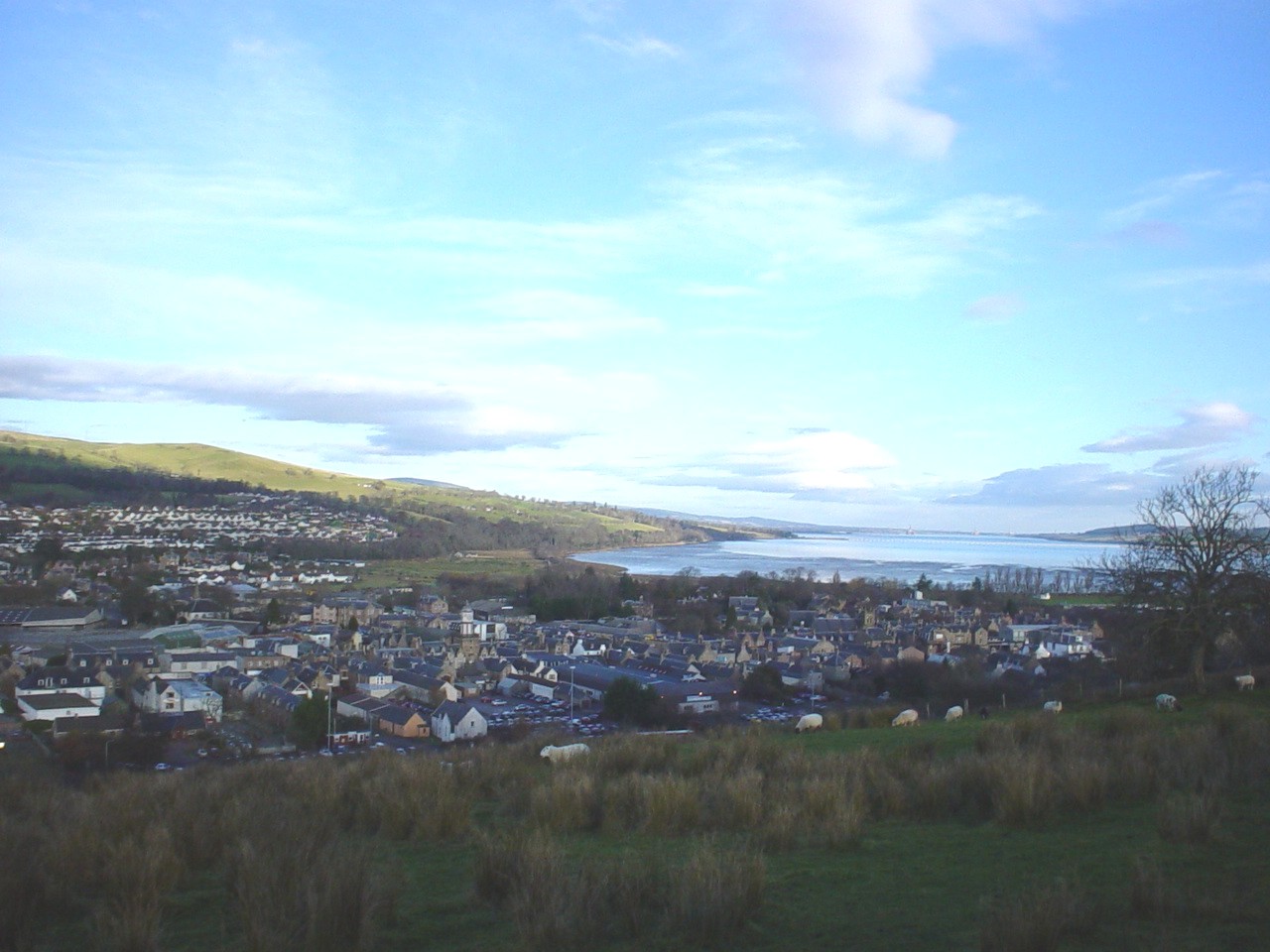
                                                                                        A view over Dingwall and the Cromarty Firth
I don't feel at home anywhere in this world, but of the few places I feel a real affinity for Dingwall is one of them. It's a strange dynamic. I couldn't live there. I know I would grow to hate it. But there is a haunting, melancholic kind of beauty hanging over that valley that never fails to find me when I visit (Runrig's music really captures some of this, especially the song--ironically--Canada), from the fog rolling in from the firth to a sunrise seen from Knockbain road amid a pastoral setting of cows quietly chewing and birds chirping. I spent a relaxed and peaceful three weeks there with Mum, Dad, and Kirsty, before flying to Madrid to relive the glory days from university for a week!

Madrid
I probably should have realized that it's a bit hard to relive your glory days in a place when all the friends from those days are no longer there. It was a bit of a quiet and lonely week as a result, but I won't deny it did my heart good to see some of the old haunts again, to visit the university campus, to walk some of the same streets again and have an incredible Madrid kebab again. The cool thing was being able to speak to the kebapci in Turkish!

U.S.A.

Me in Times Sq., NYC
After my week in Madrid I flew to New York via Dublin, where I spent a day wandering the grounds of Trinity College, eating fish and chips (a disappointing one it must be said), and trying to experience all the Irishness I could in a few hours. In New York I was met at the airport by Brad, who I hadn't seen in two years, and by Nika. My time in New York was short, but sweet: the people I was visiting had already seen the sights so many times they would've killed themselves rather than see them again, so I didn't get to do all the touristy stuff, but to be honest I was alright with that. Besides, I really wouldn't have had the time to enjoy it. Instead I did have a really fun and relaxing time walking around, and managed to take in Central Park and Times Square, and got to chow down on some amazing Japanese and Egyptian cuisine. No one can deny NYC has incredible eating options!
                     
 With Nika and Brad in NYC

After New York I flew to Montana with nothing but $46 in cash but some traveller's cheques still to cash. Imagine my horror to find out that without having a bank account at any of the banks in Bozeman I couldn't cash the cheques!! I was panicking at first, but thankfully a friend of a friend volunteered to get them cashed so I was set. After a couple of days there seeing some old friends and revisiting the university I finally flew down to Colorado to visit AJ and Marjana.

I ended up spending longer than I had planned in Cortez, CO, but it was a great time for some R & R. As well as going for a beautiful hike up in the Rockies and a surreal trek through the lunar landscape of Bisti park, I had some serious couch potato time: Marjana and AJ convinced me the show Friends really wasn't the devil, and so I finally relented and watched it. All 10 seasons of it!

                                        Hiking in the Colorado Rockies with AJ and Marjana

More than anything though, as in Scotland, it was the people and not the places that made the experience worth it. It was lovely just to spend a good length of time with family again. And although all good things must come to an end, they more often that not give way to other good things. So it was with some sadness, but also much excitement, that I finally started on my way down South, South, South...to Argentina.